
The Royal Game of Ur has an unusually appealing promise: you can look at an ancient object, learn some rules, and put a version of it back into use. But the age of the board and the age of the surviving instructions are not the same.
That difference makes the game more interesting to me, not less. We have enough evidence to discuss how people played. We do not have to pretend that every surviving board came with the same instructions.
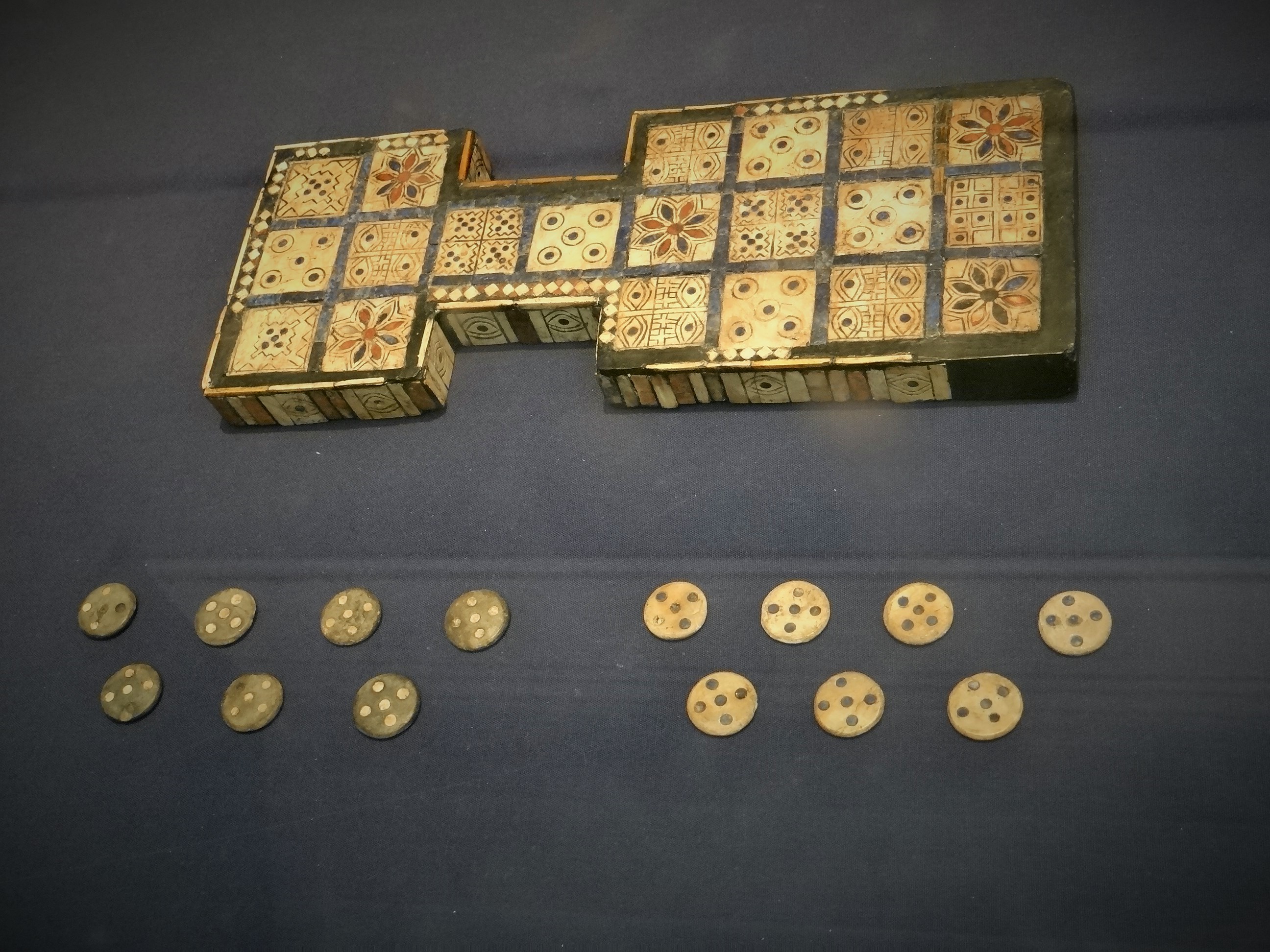

A board is not a complete set of rules
The British Museum’s famous board from Ur has twenty squares decorated with shell inlays, including flower-shaped rosettes. In the photograph, you can see how much care went into the small repeating patterns. This was not a disposable surface for keeping score.
As Anne-Elizabeth Dunn-Vaturi explains in the Met’s history of ancient board games, the Sumerian version of Twenty Squares was among the objects deposited in the Royal Graves at Ur around 2600 BCE. Related boards appeared elsewhere and in later periods. In Egypt, some gaming boxes had Twenty Squares on one side and Senet on the other.
I like that last detail. A beautifully made ancient possession could also be practical about offering two games instead of one.
Still, inspecting a board cannot answer every question a player needs answered. Where do pieces enter? Can two occupy a square? What happens after a capture? Does a special square protect a piece, grant another turn, or do something else? The marked spaces are evidence that distinctions mattered. They are not, by themselves, a complete explanation of those distinctions.
The tablet is much later
The British Museum holds a clay tablet with a diagram and rules for Twenty Squares, recorded by a Babylonian astronomer in 177 BCE. Its catalogue identifies the scribe as Itti-Marduk-balatu. That puts the written evidence more than two thousand years after the boards from the Royal Graves.
The museum’s description supplies another important detail: by the period of the tablet, the game had evolved. It involved betting and five different pieces per player. The central squares also had a use in fortune-telling.
This is not a set of instructions found beside the earliest board. It is evidence for a later form of a long-lived game.
The distinction matters whenever a modern description suggests that deciphering a tablet simply restored the original game. A later text can provide valuable evidence about an older tradition without proving that its earliest players followed every later rule. The distance between those dates is too large to leave unexplained.
Nor does that mean nothing can be known. It means that the board, the tablet, and a modern playable reconstruction each answer somewhat different questions.
A good reconstruction makes its choices clear
In her discussion of Twenty Squares, Dunn-Vaturi describes the generally assumed race: two players enter from opposite sides, move along a shared central section, and get their pieces off the board. She is appropriately cautious about the marked squares. They seem to have offered advantages, possibly protection from capture or an extra throw.
That cautious wording is useful. A practical game needs a definite answer before play begins. A historical account may need to preserve more than one possibility.
Imagine choosing between two versions in which a marked square gives different benefits. In one, your piece can stop there safely. In another, landing there lets you move again. The first encourages you to consider staying; the second rewards arriving. Even a small rule choice can change what a player tries to do.
That is my design observation, not evidence that a particular ancient player made either choice. It suggests a good way to present reconstructed games: explain the adopted rules, show which evidence supports them, and say where another interpretation remains possible. Then let people play.
The explanation does not need to interrupt every turn. A clear note before the game will do. Nobody needs an archaeological footnote each time they move a counter.
Not only the people with beautiful boards
Dunn-Vaturi also describes rough Twenty Squares tracks scratched into the bases of sculptures at Sargon’s palace at Khorsabad, around 705 BCE, which she attributes to guards playing on duty. Her wider point is that surviving gaming objects range from simple scratches to expensive boxes. Their materials do not describe the whole population of players.
The decorated board deserves attention as an object. The rough track deserves attention as evidence of an activity that did not require such an object. If we only discuss the expensive examples, we make ancient leisure look more exclusive than this evidence suggests.
For me, that is the strongest reason to make historical games playable. A replica offers something a display case cannot: decisions to make, another player to consider, and a result neither player entirely controls.
It cannot establish exactly what an afternoon in ancient Ur felt like. It can make a particular reconstruction understandable through use. That is already a worthwhile achievement, provided we keep the distinction clear.
— Envoy9